
Soon after Octavian defeated Marc Anthony and Cleopatra at the Battle of Actium in 31 BC, Egypt became part of the Roman Empire. The Nile Scribes have previously presented a Reader’s Guide to Roman Egypt and written about the famous mummy portraits that became popular during this period. This week we have the pleasure to welcome back guest blogger Stephen Ficalora to tell us about his visit to the amazing Getty Villa, a recreated Roman country house in Los Angeles, California.
Guest Scribe: Stephen Ficalora
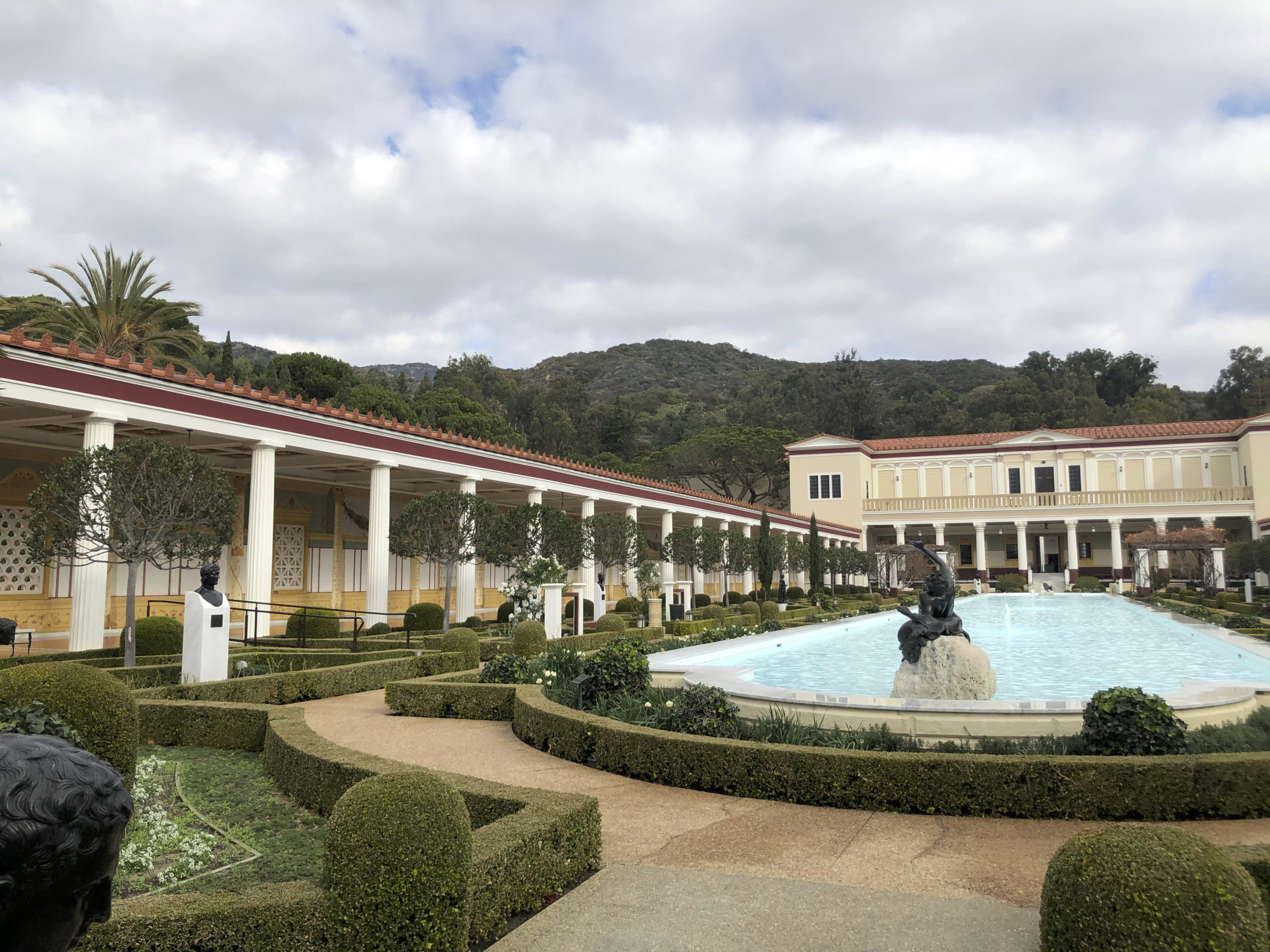
Nestled in the hills of the Pacific Palisades, just north of Santa Monica, California, lies the Getty Villa, home to the ancient Graeco-Roman art and archaeology collection of the J. Paul Getty Museum. The collection spans 7,000 years of history in the Mediterranean, from the Stone Age to the fall of the Roman Empire, with approximately 44,000 Greek, Roman, and Etruscan artefacts. The impressive collection is displayed throughout the Villa’s two floors, organised by geographic locations and historic time periods. Although the collection is the main draw for the Villa, my fascination during this visit was with the architecture of the Getty Villa itself.
The Getty Villa and Pompei’s Villa dei Papiri
The Getty Villa, built in the 1970s, was based on the plans of the Villa dei Papiri (“Villa of the Papyruses”) discovered in the Bay of Naples and destroyed by Mt. Vesuvius in 79 CE, along with the famous cities of Pompeii and Herculaneum. Visiting the Getty Villa gives visitors the unique experience of walking through a reconstructed country Roman villa meant for the elite of Pompeii or Herculaneum. Though I spent several hours perusing the collections, I spent a good deal of time admiring the museum building itself, sometimes imagining I was the Roman official who owned it…

You can enter the museum through the Villa’s “front door” and into the welcome atrium, like a true guest of the home’s owner in ancient times. The open and airy atrium gives a glimpse across its wide hall of what’s beyond.
Through the atrium, you pass into the Inner Peristyle, where the main galleries of the first floor and the central staircase to the second floor can be accessed. The hustle and bustle of visitors around this inner columned courtyard give a sense of life in the villa. You can close your eyes and imagine members of the Roman family entertaining guests around the fountain in the centre, servants going to and fro attending to the house, or the villa owner taking care of some important business. You can easily see how life in the villa converged around the Inner Peristyle.

The Temple of Hercules
On the north side of the Inner Peristyle is the Temple of Hercules. The floor is a meticulous recreation of one found at the Villa dei Papiri. The stone used in this reconstruction, imported from North Africa, Turkey, the Poloponnsos, and Greece, gives you a real understanding of the wealth needed to build such a home in ancient times and the effort it required to transport the stone from distant lands, not to mention the artisans employed in creating such works of art. The intricate, spiralling design of coloured stone tiles gives a feeling of weightlessness and otherworldliness as one stands before the statue of the god worshiped within. Though a chapel, like this one, would never have existed in a private villa like the Villa dei Papiri, it was incorporated here to display the statue of the Lansdowne Hercules, discovered at the Roman Emperor Hadrian’s villa near Tivoli, Italy. The Temple of Hercules acts as focal point for the architectural flow of the Inner Peristyle. J. Paul Getty considered the statue of Hercules the most important in his collection and it is clear he placed it at the centre of his collection.

Statue of Venus in the Basilicia
Close by, also on the north of the Inner Peristyle, is the Basilica. The First Century CE Roman historian Vitruvius is the first to use the term “basilica” to describe a large public meeting hall that was also sometimes incorporated into private homes for use as a meeting hall or private shrine. Plans of the Villa dei Papiri show a similar room with a vaulted apse at one end and a columned anteroom at the other, possibly along the lines of the reconstruction of the Basilica in the Getty Villa. Here, the Basilica acts as another chapel, this time for Venus, with alcoves dedicated to the Muses along the side walls.

The statue of Venus was discovered in Rome in 1510. Legend says the statue once belonged to Cardinal Mazarin, advisor to King Louie XIV of France.
The grandest and most memorable feature of the Getty Villa is the Outer Peristyle. In a Roman Villa, the outer peristyle was a place to entertain guests, grow plants, ventilate the house, and provide an escape from the heat. The Getty Villa recreates in vibrant colours the beautifully ornate portico of the Outer Peristyle, decorated with frescos depicting architectural features, ripe fruits and vegetables, garlands of flowers, and even hanging meats and fish ready for the kitchens. It was a quiet morning, the day I visited, and I had the opportunity to walk through these gardens and along the porticos alone, admiring the manicured gardens and reproduction bronzes found at the actual Villa dei Papiri. Any visitor could easily imagine themself as the owner of the grand country villa taking a break from a busy life in the city and spending a quiet afternoon in their garden.

Portrait Mummies of Roman Egypt
Tucked into a corner on the second story of the Villa is a small room dedicated to Roman Egypt, which features examples of the famous portrait mummies produced during the Greco-Roman period in Egypt. The central highlight of the small exhibit is the mummy of Herakleides. His mummy is wrapped in a painted shroud with gilded figures of the Egyptian gods Osiris, Isis, and Horus. A nearby tablet provides a video describing the CAT scans carried out on the mummy, which revealed that a mummified ibis was included inside his wrappings, perhaps suggesting he was priest of the ibis-headed god of writing, Thoth.

Another highlight of the display is the portrait from the mummy of Isidora. Her portrait is painted on wood, and like the mummy of Herakleides, was surrounded by a red-painted shroud. Her wealth in life is easily visible: Isadora wears a gold wreath in her hair, and jewelry embedded with pearls, emeralds, and garnets. Unfortunately the provenance for the portrait is unknown, but the curved top of the panel suggests it might be from Hawara. These mummies represent a special time in Egypt, when worlds and traditions collided, mixing old ways with new technologies. Though the exhibit makes up a small portion of the Getty Villa’s collection, the exquisite, high quality examples are at home in an equally exquisite building.

The Getty Villa provides a unique way to experience the archaeology of the Mediterranean world. The recreated Roman villa is in itself the grandest piece of the museum’s collection. It is one thing to visit an archaeological site, walk through the ruins of buildings, see the faded and chipped frescos still in place or in a museum, but to be able to walk through a full scale, actual building for yourself is an entirely different experience and was my absolute favourite part of visiting the museum. I encourage anyone visiting the Getty Villa to take a few moments alone in one of the gardens, close your eyes, and imagine for a moment you’re that wealthy Roman citizen in your country estate, escaping from the craziness of Pompeii, the scent of fresh lemons or oranges mixed with rosemary from your garden in the breeze of the quiet morning. I just hope a volcano doesn’t erupt while you’re doing so!


Stephen Ficalora is an Egyptology Ph.D. candidate at the University of Toronto. He completed his Masters in History with a focus on Egyptology at the University of Memphis in 2013 and his Masters in Near and Middle Eastern Civilizations at the University of Toronto in 2014. In the summer of 2013, he was able to participate in the Epigraphic Study of the Hypostyle Hall at Karnak Temple and experienced the Abu el-Haggag festival in Luxor.
All photos are courtesy of the author.
You must be logged in to post a comment.